The Gaza war brings the Arab community in Britain back into the spotlight
London – After months of ongoing protests condemning the Israeli genocide in Gaza, the Arab communities in Britain are seeking to transform the popular momentum into organized and effective political action, in order to influence British decision-making circles in favor of the Palestinian cause.
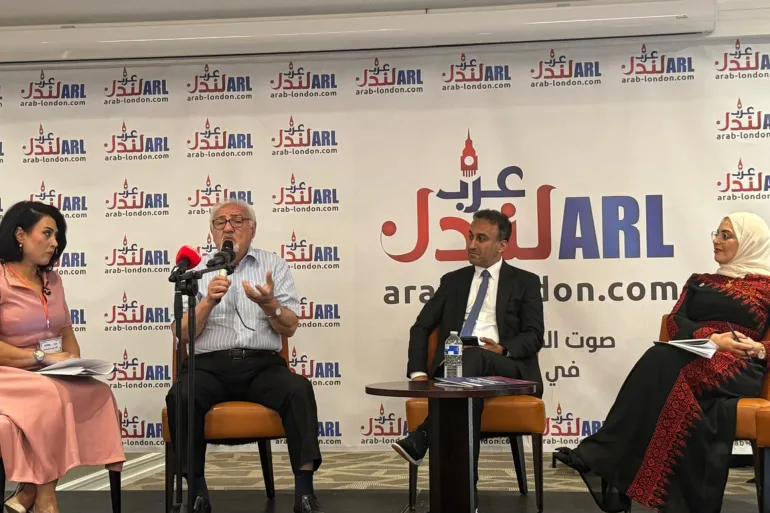
This momentum was reflected in the launch of the first Arab Community Conference in Britain, with the participation of a group of political and intellectual figures from the Arab communities, in a step considered the first of its kind, aiming to build on the unity that appeared between the Arab civil and political forces in the United Kingdom in support of Palestine, in order to establish a pressure and organized framework on the British government.
The Palestinian ambassador in London, Husam Zomlot, considered in his speech at the conference that Britain represents a central arena of confrontation with the Zionist narrative, due to the historical role played by pro-Israel lobbying groups in entrenching this narrative within British society and its institutions.
In a special interview, Zomlot confirmed that the popular movement supporting Palestine in Britain — which has continued in an unprecedented way for more than two years — represents an opportunity that must be seized and transformed into an institutional path based on a unified and effective Arab effort, in light of what he described as “important breakthroughs” achieved by this movement within British society.
Since the outbreak of the Israeli war on Gaza in October 2023, London has witnessed massive and repeated demonstrations, called for by British civil and human rights organizations, and joined by wide segments of youth and political movements. These demonstrations have been considered among the largest in modern British political history.
Although the Arab community in Britain does not exceed 356,000 people according to the latest official statistics, the solidarity movement with Palestine after the Gaza war has gone beyond the Arab and Islamic framework to include British organizations and groups that consider the Palestinian cause a global symbol of the struggle for justice and independence.
The editor-in-chief of “Arab London Platform” and one of the conference founders, Mohammed Amin, says that the Arab communities have begun to realize their delay in building a political influence system, and are seeking to form an active Arab lobby within the United Kingdom, through a network of alliances that invests the widespread popular sympathy with the Palestinian cause.
Amin adds that the Zionist movement realized a century ago the importance of organized work, conferences, and political gatherings in building its influence, while Arabs in Britain were late for a long time in realizing this fact.
Although the Arab communities do not constitute a large electoral bloc in Britain, Arab activists have launched specific political initiatives, most notably the “Arab Vote” campaign in cooperation with the “Muslim Vote” campaign, to direct voters’ voices toward candidates supporting the Palestinian cause, in an approach described by observers as “political bargaining” between votes and positions.
The previous parliamentary elections resulted in only two candidates of Arab origin winning parliamentary seats, but political support for Palestine has expanded within Parliament, with new blocs of independent MPs supporting Gaza being formed, along with moves within some major parties to push them toward clearer positions on the Israeli aggression.
Chris Doyle, director of the Council for Arab-British Understanding, stresses in a statement to Al Jazeera the importance of enhancing the representation of Arab communities within British institutions, calling for overcoming partisan identities and ideological backgrounds and unifying Arab interests within the country.
However, these political efforts sometimes face internal challenges, as many believe that Arab communities transfer their political conflicts from their home countries to the diaspora, reproducing divisions instead of building a unified front.
In this context, the Secretary-General of the Palestinian National Initiative, Mustafa Barghouti, called in his speech during the conference for overcoming the political divisions that Arab societies have suffered from, and for working to present a new model of unity for the Arab community in Britain.
Barghouti stressed the necessity of escalating boycott campaigns against the Israeli occupation in Britain, and protesting the continued export of weapons to Israel, in light of what he described as “symbolic and timid” British government positions.
Recently, a number of parliament members have increased their demands that Keir Starmer’s government impose a comprehensive ban on arms exports to Israel, while the Palestinian organization “Al-Haq” filed a lawsuit against the British government to push it to stop exporting spare parts used in F-35 aircraft, which are a main pillar of the Israeli air force.
Starmer’s positions supporting Israel also caused splits within the Labour Party, as ten MPs and dozens of local council members left the party in November 2023 in protest against his statements, while several MPs belonging to the party’s left wing continue to pressure its leadership to change its approach toward the aggression on Gaza.
Starmer has already begun adopting a more hardline rhetoric toward Israel, as he announced sanctions on two ministers in the Israeli government and suspended trade partnership talks with it.
However, this political path is not free of additional challenges, most notably the rise of far-right rhetoric in Britain, especially after the notable results achieved by the populist Reform Party in the recent local elections, which raised concerns among Arab and Muslim communities about the rise of racism and their political marginalization.
Source: Al Jazeera News (link)