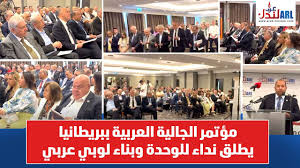
Arab London Platform organized on Sunday the first edition of the Arab Community Conference in the British capital under the theme “Loyalty to the Friends of Palestine,” aiming to unify efforts and build an active presence that moves beyond charitable work toward organized and influential political action on the Palestinian cause.
The conference was opened by the platform’s editor-in-chief, journalist Mohammed Amin, who stressed that the Arab community faces complex challenges, ranging from the rise of the far right to the repercussions of the war on Gaza and issues of integration. He underscored the need to coordinate efforts and develop a unified vision to activate the potential of Arabs in Britain.
In his keynote address, the Palestinian Ambassador to the United Kingdom, Husam Zomlot, noted that nearly £1 billion in annual donations from Arab and Muslim communities in Britain is directed toward relief efforts, while less than 1% is allocated to strategic work. “We are bleeding and need bandages, but we cannot settle for treating the wounds alone. We must address the root causes of the bleeding,” he said. Zomlot added that Palestinian diaspora communities have contributed more than $4 billion to Palestine-related causes, making them among the most generous globally relative to their size. However, spending on what is termed “strategic work” does not exceed $45 million annually—equivalent to just three dollars per person per year.
Strategic work refers to efforts aimed at ending the Israeli occupation, achieving liberation, and alleviating suffering. Chief among these is the battle over narrative—seeking to reclaim the Palestinian story from distortion and misrepresentation, as pursued by media platforms such as Arab London. This also includes legal advocacy, with activists emphasizing that international law supports the Palestinian cause, yet has often been used to shut down Palestinian institutions under tenuous legal pretexts, despite the presence of highly capable Palestinian legal professionals.
For his part, Mustafa Barghouti, Secretary-General of the Palestinian National Initiative, highlighted the importance of the “battle of narratives” in the West, stating that mass demonstrations in London and other European cities have “exposed the occupation.” He called on the community to capitalize on this momentum to achieve tangible political influence within parliamentary institutions.
Chris Doyle, Director of the Council for Arab-British Understanding, said that Arabs in Britain have made significant progress since the 1990s, pointing to the rise of prominent figures of Arab descent to influential positions, such as MP Layla Moran and Financial Times editor Roula Khalaf. He urged that this progress be leveraged to build a stronger political presence.
Palestinian-British writer and physician Ghada Karmi cautioned against reducing the conflict solely to the Israeli occupation, arguing that the issue is broader and tied to an international system that allows crimes to go unpunished. She called on the community to better understand Western societies and engage strategically without compromising their identity. In a similar vein, Sabah Al-Mukhtar, honorary president of the conference and former head of the Arab Lawyers Association, emphasized the importance of preserving the identity of younger generations, advocating for positive integration that balances civic engagement with cultural belonging through effective educational and cultural initiatives.
British doctor Graeme Groom, who volunteered in Gaza, recounted his testimony of the atrocities he documented, describing the experience as life-changing and urging continued international pressure to end the war. A recorded message from Dr. Victoria Rose, who worked alongside him, expressed gratitude to the community for honoring her and reaffirmed her commitment to supporting the Palestinian cause. Media figure and activist Dalal Jibril called for moving beyond personal differences and focusing on shared goals, stating: “Despite the complexities of the political landscape, hope remains when we unite around a single message: action over words, and the public interest above individual ambitions.”
Honors and Recommendations
The conference concluded by honoring several Arab and British figures supportive of Palestine, including Drs. Groom and Rose, journalist Myriam Francois, Professor Amin Al-Habaibeh, activist Ben Jamal, athlete Jalal Shahin, and the late Moroccan journalist Ayoub Al-Rimi.
The final recommendations included establishing a unified Arab institution and a higher council to coordinate diaspora efforts, forming an Arab lobbying body within British politics, supporting younger generations through student and volunteer initiatives, launching an independent Arabic-language radio station to represent community concerns, and developing an effective electoral strategy reflecting the growing voting power of Arabs in the United Kingdom.